Sunday, May 27, 2012

Museum: Art Gallery


The Melaka Art Gallery is located at Jalan Laksamana, Bandar Hilir. The gallery displays various artworks of local and foreign artist. The Melaka Art Gallery is also known as the PERZIM Art Gallery.


There are about 190 artworks displayed here in the following galleries:

Melakan Artist Gallery
Malaysian Artist Gallery
Foreign Artist Gallery
Junior Talent Gallery

Amongst the local talents displayed here include:

Rafie Abd Rahman
Wan Hui-Jyu
Rahmat Ramli
Rafie Abd Ghani
Jehan Chan
Gerard Van Den Oetelaar


Entrance fee for adults is RM1 and RM 0.50 sen for children.

Museum: People Museum


This building was occupied by the Melaka Historical City Municipal Council before being taken over by the Museum Corporation (PERZIM). The Museum is located on the 1st floor and was officially declared open by the Prime Minister of Malaysia on April 15, 1992.

The Museum main exhibits are on the various aspects of Melaka - the administrative structure, the social infrastructure, tourism, the manufacturing and industrial sector, the agricultural sector etc - and how they evolved and developed through time.  Yet the main subject of these exhibits is the people involved in these activities.  The Museum tried to capture the essence of Melaka through its people.  An exhibition to mark the rapid growth of Melaka from 1982 to 1992 known as "Melaka - A Decade of Growth 1982 -1992" has been incorporated into the People's Museum.

  
The museum showcase Melaka's achievements in the development sector. The exhibition also highlights the integration between the State Government and the people, working in tandem, towards a developed Melaka come 2010.

Operation Hour:
9.00 AM- 5.30 PM
(Open Daily)


Admission Fee:
Adult RM 2.00
Children/Student RM 0.50

Info: Bukit Katil


Masjid Bukit Katil

Tahukah anda tentang sejarah dan asal usul nama Bukit Katil? Pembukaan awal kampung berkenaan mempunyai keistimewaan tersendiri. Menurut Sidang Kampung Bukit Katil, Abdul Ghani Maarof, 63, beliau mengetahui sejarah awal pembukaan kampung berkenaan berdasarkan cerita yang disampaikan 'orang-orang tua' di situ secara turun-temurun mengenai asal usul nama berkenaan. 

Berdasarkan cerita disampaikan, penduduk terdahulu dikatakan menemui batil emas (bekas simpanan air) seperti labu sayong yang terletak di atas batu berbentuk seakan katil di atas puncak bukit di situ (bukit terletak bersebelahan Sekolah Rendah Kebangsaan Dato' Demang Hussin).

Rumah Melaka (Pusat Perkayuan Negeri Melaka)

Penemuan batil emas di bukit terbabit sekali gus membawa kepada terciptanya nama Bukit Katil yang digabungkan antara bukit dan batu didakwa berbentuk seperti katil, selain bekas menyimpan air yang ditemui ketika itu. Nama Kampung Bukit Katil tercipta selepas kemasukan pihak British ke Melaka pada waktu dahulu.

Kampung Bukit Katil meliputi empat solok iaitu Solok Bukit Bayan, Solok Telok, Solok Tambak dan Solok Balik Hutan (kini dikenali sebagai Solok Kampung Baru atau Kampung Desa Wawasan).

Bagaimanapun, berdasarkan fakta sejarah, kampung asal Bukit Katil adalah Bukit Sama Tahu (selepas itu dikenali sebagai Solok Pantai) yang terletak di pinggir pertemuan Sungai Gapam dan Sungai Ayer Panas (Sungai Tehel).

Fakta sejarah juga mencatatkan pertemuan dua sungai berkenaan yang bercantum dengan Sungai Duyong menjadi laluan askar kerajaan Melayu Melaka yang lari daripada serangan tentera Portugis selepas kejatuhan Empayar Melaka.

Ketika melarikan diri, sebahagian daripada tentera kerajaan Melaka ketika itu ada yang mudik ke Ulu Duyong manakala sebahagian lain pula meneroka kawasan di pinggir pertemuan Sungai Gapam dan Sungai Ayer Panas seterusnya membuka perkampungan di situ dan menamakannya Bukit Sama Tahu.

Menurut Sidang Abdul Ghani, berdasarkan pengetahuan silam seorang penduduk, Allahyarham Dalip Said dari Solok Balik Hutan, asal asul pembukaan Kampung Bukit Sama Tahu mempunyai versi yang agak unik apabila mereka yang mula meneroka tempat berkenaan dikatakan terjumpa seekor kijang bertanduk emas.

Bagaimanapun, disebabkan pantang-larang orang dulu kala yang pada masa itu dipegang teguh, maka mereka bertindak merahsiakan perkara berkenaan sesama mereka dengan berjanji bahawa 'kita sama kita saja yang tahu'.

Dengan itu, kampung yang dibuka di situ pada masa itu diberikan nama Bukit Sama Tahu sempena rahsia disimpan di kalangan penduduk asal terbabit," katanya mengisahkan serba sedikit sejarah kewujudan Kampung Bukit Katil.

Selepas kampung berkenaan wujud barulah penempatan lain di kawasan berdekatan mula diterokai penduduk lain. Sejarah mengenai asal usul Kampung Bukit Katil mendapat nama tidak banyak berbeza dengan apa yang diceritakan seorang penduduk lain, Abu Samah Mohd, 64.

Menurut cerita disampaikan kepadanya oleh bapa beliau, Mohd Lamin, yang lahir pada 1918, moyangnya yang berhijrah dari Kedah dan menetap di Kampung Pengkalan Badak mendapati sudah ada rumah atau penempatan penduduk di kampung bersebelahan iaitu Kampung Bukit Katil.

Nama Bukit Katil berkemungkinan diperoleh penduduk pertama yang menjumpai batil iaitu bekas menyimpan air ketika menebang pokok di puncak bukit apabila mula meneroka kawasan di situ. Berkemungkinan juga penduduk pertama yang meneroka kawasan bukit di sini menamakannya seumpama itu selepas menjumpai batil di atas batu seakan bentuk katil sempena penemuan itu.

Sorotan sejarah juga menunjukkan penghubung laluan kampung berkenaan untuk ke bandar Melaka pada masa lampau menggunakan laluan menerusi Sungai Gapam dan Sungai Duyong. Manakala jalan asal kampung terbabit adalah jalan kereta lembu yang digunakan penduduk dari Duyong melalui Solok Tambak ke Bukit Bayan hinggalah ke Bukit Sama Tahu dan Balik Hutan.

Selepas penjajahan Inggeris pertama, maka pihak penjajah bertindak membina jalan di lokasi sedia ada untuk kemudahan penduduk mengangkut hasil getah dari Ladang Getah Bukit Katil Home Division ke bandar (pelabuhan) manakala Jalan Bukit Katil diturap pada 1960.

Secara amnya, penduduk Kampung Bukit Katil pada waktu dulu kebanyakannya menyara diri dengan menjual kayu api seperti kayu getah dan kayu gelam untuk memasak dan dihantar ke bandar menggunakan kereta lembu termasuk basikal yang ketika itu sebagai nadi pengangkutan utama. Selain itu, mereka turut bercucuk tanam termasuk menanam padi.

Kawasan sekitar Kampung Bukit Katil pada suatu masa dulu dikelilingi pokok getah dan sawah padi kini membangun dengan pesat apabila dikelilingi pejabat agensi kerajaan seperti Jabatan Pengangkutan Jalan (JPJ), Jabatan Kimia, sekolah, taman perumahan termasuk masjid.

Malah, terdapat juga produk terbaru tarikan pelancong iaitu Rumah Melaka yang menempatkan pelbagai perabot kayu dan tradisional daripada seluruh negara kini diwujudkan di situ oleh kerajaan negeri.

Namun di sebalik pembangunan pesat, terdapat seorang tokoh tempatan, Demang Hussin Maaji yang dikatakan pernah menabur bakti dengan menyumbang peranan penting dalam pembangunan ilmiah sehingga namanya diabadikan pada sebuah sekolah rendah.

Sekolah berkenaan dulunya dikenali sebagai Sekolah Melayu Bukit Katil (sekolah atap diperbuat daripada kayu dan atap rumbia dan berlantaikan tanah) dibina pada 1924, tetapi lokasi asalnya terletak di Solok Tambak berhadapan Masjid Jamek Bukit Katil sekarang.

Ketokohan Demang Hussin Maaji terbukti apabila beliau ketika hayatnya juga dikenali sebagai guru mengaji, guru besar sekolah diasaskannya selain pernah dilantik sebagai Ketua Penghulu atau Demang bagi Mukim Bukit Katil, Duyong dan Semabok di zaman penjajahan Inggeris.

Museum: Literature Museum


The Literature Museum is located at a building near the Stadthuys that used to house the Melaka State Development Corporation.

The museum pays particular attention on the Malays history of writing and their literature, right from the Melaka Sultanate period till the present.  It exhibits important historical records of Melaka, such as the 'Malay Annals', 'Hikayat Hang Tuah', 'Hukum Kanun Melaka' (Punishment Under Canon Law), and the writings of Munsyi Abdullah and some local Malay folklore.


The exhibits also include graphic representations in the form of paintings based on events described in the Malay Annals and the execution of penalties as provided under the 'Hukum Kanun Melaka and copies of original handwritten historical manuscripts from many parts of the world.


Traditional literary genres such as 'pantun', 'gurindam', 'nazam', and 'puisi' (poetry) are also given due recognition. The gallery honouring national and local writers is very popular among visitors.


The museum also keep and preserve literary works from the earliest times to the present for posterity, promote the development of literature, and honour Malay writers and poets of note by featuring them in museum displays and exhibitions.

Operation Hour:
9.00 AM- 5.30 PM
(Open Daily)

Admission Fees:
Adult RM 5.00
Children/Student RM 2.00

Wednesday, May 23, 2012

Museum: Kites Museum


This museum is located on the fourth floor of the building housing the People's Museum in Jalan Kota, Bandar Hilir, Melaka. The museum was officially opened by the Chief Minister of Melaka in September 1995 in conjunction with the 'Regional Malay Customs' seminar.


The museum explicates how, since its invention, the kite has served Man as a means of long distance communication, a weapon of war, a sport and as a leisure activity. The museum also displays how kites are made in various countries, the different materials they are made with, and the role kites play in the cultural life of the people of those countries.


The museum displays kites, traditional and modern, of different shapes and sizes, from many different parts of the world. The Nusantra Wau is also on display.


The Museum of Kites is a must for all and not just kite lovers, as the museum reveals the important role that kites have played in Man's progress. 


Operation Hour:
9.00 AM- 5.30 PM
(Open Daily)

Admission Fees:
Adult RM 2.00
Children/Student RM 0.50

Museum: Historical and Ethnography Museum


The Historical and Ethnography Museum is located at the Stadhuys at the junction of Jalan Kota and Jalan Gereja, Melaka. In front of the building, in an area known as Dutch Square, is the Victoria Water Fountain and the Tan Beng Seng Clock Tower built in the year 1886. The Historical and Ethnography Museum is on the second floor of the Stadhuys building.


The museum portrays the lifestyle of the different communities and sub-communities that make up the population of Melaka - the Malays, the Chinese, the Indians, the Portuguese, the Baba and Nyonya, the Chetti and Chitty communities.


Among the exhibits on display are items used in traditional wedding ceremonies, kitchen utensils, musical instruments and collections of ancient porcelain ware. There are also collections of ancient weapons, stamps and various currencies.


The first floor of the Historical and Ethnography Museum is devoted to the history of Melaka which in reality is the early history of Malaysia. It covers the period from the founding of Melaka to the establishment of independent Federation of Malaya. The exhibits provide a true reflection of early Melaka, its existence as a colony, the struggle for independence and the rapid development of post-independence Melaka.


The Historical section of the museum is devoted to the history of Melaka from its establishment in 1400 to 1957, the year it gained independence. The Ethnography section of the museum portrays the lifestyle and culture of the various communities and sub-communities that make up the multi-racial society of Melaka.

Operation Hour:
9.00 AM- 5.30 PM
(Open Daily)

Admission Fees:
Adult RM5.00
Children/Student RM2.00

Sunday, May 20, 2012

Museum: Melaka Islamic Museum


The Melaka Museum of Islam was set up to be not only a display centre of documents and artifacts pertaining to Islam but also to be a centre for research into the coming of Islam into Melaka and its subsequent spread to the rest of Malaysia.


The Melaka Museum of Islam is located at a building in Jalan Kota which used to house the office of the Melaka Islamic Council ( Majlis Agama Islam Melaka - MAIM). To house the museum the interior of the building was renovated extensively to reflect the glory splendor of Islam. The renovation efforts combined the finest traditions of Islamic art and local and regional craftsmanship.


The Melaka Museum of Islam has eight main exhibition areas, each with its own theme. The exhibits are arranged in chronological order to give visitors a quick historical perspective of the coming of Islam to Melaka and its spread to the rest of Malaysia.


Amongs the exhibits are outsized editions of the Quran, some with enlarged Arabic characters as much as four of fives inches broad, a striking copy in Mandarin and a hand written copy. Also displayed are periodic books publish on Islam. Another section exhibits Islamic artifacts such as a twenty-inch keris display box minutely inscribed with Quranic verses, coins and weaponry intricately worked with khat calligraphy and Islamic inscriptions from the Quran.


There is also a round porcelain plate of Dutch origin decorated with Islamic inscription that pertains to the Dutch occupation. Exhibits also include several paintings of the older mosques in Melaka including the Peringgit Mosque, built in 1720. Standing unobstrusively in the Museum compound is an inscribed stone in Arabic that provides the first record of Islam being the official religion of a Malay rulers in the Peninsula during the 13th century. A flood unearthed the two feet high stone found in a place 32 miles from Kuala Terengganu in 1902.


 Another stone in the compound is said to be the tombstone of an Islamic ruler, Sultan Malik Al' Salih who died in 1297. It was found in Pasai, Aceh in the neighboring island of Sumatra. The museum was built to portray Islam as Ad-Din (the true and righteous spiritual path to salvation) and the glory of Islamic Civilization and to encourage a greater understanding of Islamic knowledge and be a resource centre for researchers and scholars studying the history of Melaka and Islam. 


The museum also showcase the role of Melaka in the history of Islam in the region and Melaka's ancient links with other centers of Islamic civilization in places such as India, China, Arabia and other parts of South East Asia.

Operating Hours
Open daily: 9.00am to 5.30pm
Closed on Monday

The Melaka Islamic Museum,
Melaka Museums Corporation,
Jalan Kota, 75000 Melaka.

Tel: 06 282 2973
Fax: 06 282 6745

Museum: Admiral Cheng Ho Gallery


The Admiral Cheng Ho Gallery was inspired from the legendary Admiral Cheng Ho (Zheng Ho), China’s distinguished sea admiral.  He was born in 1371 at Hodai, a village in Bao San province of Yunan.  His birth name was Ma Ho and his other name was San Bao.


The gallery showcases the Admiral’s journey to the Southern sea and his great feat in international relations where he established China’s great affiliation with the African and Asia countries leading to a prosperous and fair trading amongst them.


The location of this gallery is near the right facade of the Stadthuys building (The Museum of History & Ethnography) and in between the Literature Museum and the Democratic Government Museum.  Among its main exhibits are porcelains, ship replicas, collection of books about Admiral Cheng Ho’s life and adventures and some related articles about him.

This gallery was open for the public on February 2003 alongside the opening of the Museum of History & Ethnography and the reopening of Malaysian Youth Museum.

Operation Hour
9.00 AM- 5.30 PM
(Open Daily)

Admission Fee
Adult RM5.00
Children / Student RM2.00

Wednesday, May 16, 2012

Museum: Democratic Government Museum


The museum was once the Melaka’s State Legislative Assembly building where its foundation stone was laid on August 31st1961 by the then Governor Tuan Yang Terutama Tun Haji Abdul Malek bin Yusof S.M.N, D.M.K.  


In this Assembly building, Melaka State Legislative Members congregated and hold conference for discussions and passing of local bills and rights along with the annual State budget presentation.  The State Legislative Assembly is chaired by a Speaker, who is elected by the members of the House.  


The legislative members are themselves elected by the people during an election held once every five years or after the dissolution of the Assembly. Those eligible to stand for election have to be a Melaka residents and over the age of 21. The State Legislative Assembly since February 2000 had been relocated to Ayer Keroh following the State government decision to centralize its management, administrative and official affairs.


At present, this building is the Democratic Government Museum which houses information and documentation of records of Malaysia’s past and present governance with exclusive attention on its practice of democracy.  The museum partake exhibitions tracing back chronologically, events that leads to Malaysia’s day of independence.  The museum also holds records of Malaysia’s achievements in its governance system.


It is hoped that the establishment of this museum would give visitors better comprehension on the Malaysia’s constitutional system of government. The museum record Malaysia’s development and its administrative and governance system in accord with the international governance system. Its also provide knowledge and understandings to the Malaysian public on Malaysia administration system.


The museum also equip the younger generations with knowledge of nationalism and rules & order of a country and choices made by any one countries in adopting their ideology towards achieving a grand civilization. Besides, its showcase Islam as a way of life and how the Malay society in Malaysia had successfully integrated the Islamic principles into nation-building that encourages peace, friendship, prosperity and loyalty as evidenced in the National Code.

Admission Fees:
Adult RM5.00
Children /Student RM2.00

Operation Hour:
9.00 AM- 5.30 PM
(Open Daily)

Tuesday, May 15, 2012

Museum: Malaysia Youth Museum


The Malaysia Youth Museum or Muzium Belia Malaysia was officiated by the former Prime Minister of Malaysia,Y.A.B Datuk Seri Dr. Mahathir Mohamad, on April 15 1992.

The museum is housed in the historical Dutch building that used to be the Dutch administration office. The building was also used as a Anglo-Chinese School. In 1931, the British converted it into a General Post Office. Today, the building houses the Malaysia Youth Museum. (A small post office is still in operation at the other end of the building).

The museum is dedicated to the contribution made by the youth in the country economically and socially. The museum houses and exhibits documents, information and paraphernalia related to local and international activities of various Malaysian youth organisations.


Photographs of past and present youth leaders, uniforms worn by members, awards and trophies received, and handicrafts made by members of youth organisations and youth co-operatives are among the exhibits displayed at the Malaysia Youth Museum.

The Melaka Art Gallery is located on the second floor of the Malaysia Youth Museum.

Operation Hour

Open daily from 9.00 a.m. to 5.30 p.m.  Closed on Monday

Admission Fee

Adult – RM1.00
Children / Students – RM0.50

Contact Details

Melaka Museum Corporation
Kompleks Warisan Melaka
Jalan Kota
75000 Melaka.

Tel: 06 – 282 6526/281 1289/281 4872
Fax: 06 – 2826745

Thursday, May 10, 2012

Museum: Museum of Custom and Tradition


The Museum of Traditional Custom is located at the Alor Gajah Square, next to the Alor Gajah Municipal Council’s Keris Monument.  This museum is approximately 25 kilometers away from Melaka Town.  The Traditional Malay House is the main identity for the museum.


The museum’s main focus is on the early history of Alor Gajah including displaying photographs of the district’s icons and exhibiting the Malay marriage customs and rituals with particular attention on the Regional Malays.  Among materials exhibited are the bridal stage, wedding accessories, porcelains and the customs and rituals appliances.


On 19th October 1990, the Melaka Chief Minister Tan Sri Abdul Rahim bin Datuk Tamby Chik officiate this museum.  This building was under the management of Alor Gajah Municipal Council before it was taken over by PERZIM.


Built in 1989, this building initially known as Alor Gajah District Museum. This museum exhibits artifacts and the socio-economic activities of the local communities of Alor Gajah District. The role of the museum was later shifted to include the dissemination of knowledge to the public about the customs and traditions among the Malay society of Melaka.


The concept of the exhibition focuses on the history of Alor Gajah which includes the history of various prominent figures of the district and customs and traditions of the Malay wedding ceremony. Museum of Custom and Tradition also reflects the architecture of a traditional Malay house, which is now one of its main attraction.


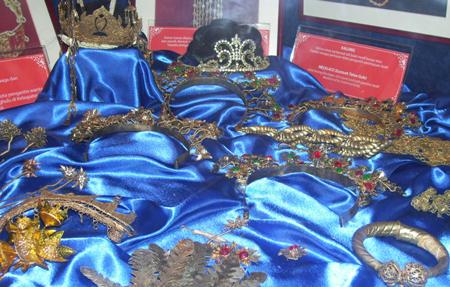
Now Museum of Custom and Tradition has become a resource centre on information related to the customary practices of the local Malay wedding ceremony as well as wedding practices throughout the  archipelago. Various dioramas have been set up on important wedding ceremonial events such as the “akad nikah” (the bethrotal ceremony) and the “bersanding” (the wedding). The different types of “pelamin” (bridal ceremonial dias), display of a bridal room and traditional wedding costumes and garments are also exhibited in Museum of Custom and Tradition.


Operating Hours : 9.00 am - 6.00 pm
Free Entrance
Closed on Mondays
Tel. No. : +606-556 3875

Tuesday, May 01, 2012

Melaka Cuisine: Lempeng Kelapa


Lempeng kelapa merupakan juadah tradisi paling istimewa dan lazat orang-orang Melaka. Lazimnya penduduk kampung di Melaka akan menyediakan lempeng kelapa yang dimakan bersama sambal tumis atau kari sebagai sarapan pagi untuk dihidangkan kepada ahli keluarga. 


Lempeng kelapa sangat mudah dan cepat disediakan malah bahan-bahannya juga sangat mudah didapati menjadikan makanan ini sebagai pilihan untuk dijadikan juadah untuk minum petang dan sarapan pagi.


Bahan-Bahan Lempeng Kelapa:

1 1/2 cawan kelapa muda parut
1 cawan tepung gandum
1 cawan air (kurang lebih)
Garam secukup rasa

Cara-Cara:

1. Campurkan semua bahan diatas dan kacau hingga rata, jika kelihatan terlalu pekat boleh tambah 1 - 2 camca besar air. Kacau dengan rata dan rehatkan sebentar.
2. Panaskan kuali dengan sedikit minyak masak. Sendukkan sedikit adunan dan ratakan, lalu dimasak dengan api yang sederhana sehingga permukaan lempeng kelihatan kering.
3. Terbalikkan lempeng dan masak lagi hingga sedikit garing, kemudian angkat. Buat kaedah sama untuk baki adunan. Hidangkan bersama sambal tumis kegemaran anda.

Museum: Melaka Aboriginal Museum


The indigenous people of Peninsular Malaysia are called ‘Orang Asli’ or aborigines. Malaysian Government introduced the phase ‘Orang Asli’ in the 1950s referring to small cluster of people who live deep in the Malaysian rain forest. 


The element of magic and ritual (pagan) are famous in their culture making this ‘Orang Asli’ called a primitive. They also believe in forest or nature spirit where all daily activities must be blessed by the spirits or if not they will be cursed for their whole life. 


In reality we may say they are poor and lag from current technology. But if we look in different point of view, the indigenous people also develop their own standard of living and technology in order to suit in the environment they live in. They have their own culture and skills which are related with the forest and nature. 


They have their own musical instruments and dances which are very interesting and unique. They make mask and clothing made from plant for their sacred ceremony. At Melaka Aboriginal Museum, the tools used by all tribe of the indigenous people in Malaysia are displayed. It is located just about 2 km from Ayer Keroh toll and beside the Melaka Crocodile Farm. The museum was officially open in 3rd February 1997 and visitors can find information about the main aboriginal tribes history in Malaysia like Senoi, Jah Hut and Mah Meri here.


The Museum consists of five gallery with five different themes. The themes displayed at the gallery are; method for catching the fish, agriculture tools, aboriginal kitchen, sleeping room, and weapons. Most attractive subject are the hunting tools and the sermon tools that kept undiscovered mysteries about the tribes black magic practices and witch crafts.


The museum building are adapted from the aboriginal wooden houses that utilize tree bark, bamboos and logs with no concrete structures at all. 


Opening Hours:
Open everyday from 9.00am to 5.30 pm. (accept Monday)

Admission Fees:
Adult : RM1.00
Children : RM0.50.

Contact: 606-2317932