Showing posts with label Info. Show all posts

Sunday, May 27, 2012

Info: Bukit Katil


Masjid Bukit Katil

Tahukah anda tentang sejarah dan asal usul nama Bukit Katil? Pembukaan awal kampung berkenaan mempunyai keistimewaan tersendiri. Menurut Sidang Kampung Bukit Katil, Abdul Ghani Maarof, 63, beliau mengetahui sejarah awal pembukaan kampung berkenaan berdasarkan cerita yang disampaikan 'orang-orang tua' di situ secara turun-temurun mengenai asal usul nama berkenaan. 

Berdasarkan cerita disampaikan, penduduk terdahulu dikatakan menemui batil emas (bekas simpanan air) seperti labu sayong yang terletak di atas batu berbentuk seakan katil di atas puncak bukit di situ (bukit terletak bersebelahan Sekolah Rendah Kebangsaan Dato' Demang Hussin).

Rumah Melaka (Pusat Perkayuan Negeri Melaka)

Penemuan batil emas di bukit terbabit sekali gus membawa kepada terciptanya nama Bukit Katil yang digabungkan antara bukit dan batu didakwa berbentuk seperti katil, selain bekas menyimpan air yang ditemui ketika itu. Nama Kampung Bukit Katil tercipta selepas kemasukan pihak British ke Melaka pada waktu dahulu.

Kampung Bukit Katil meliputi empat solok iaitu Solok Bukit Bayan, Solok Telok, Solok Tambak dan Solok Balik Hutan (kini dikenali sebagai Solok Kampung Baru atau Kampung Desa Wawasan).

Bagaimanapun, berdasarkan fakta sejarah, kampung asal Bukit Katil adalah Bukit Sama Tahu (selepas itu dikenali sebagai Solok Pantai) yang terletak di pinggir pertemuan Sungai Gapam dan Sungai Ayer Panas (Sungai Tehel).

Fakta sejarah juga mencatatkan pertemuan dua sungai berkenaan yang bercantum dengan Sungai Duyong menjadi laluan askar kerajaan Melayu Melaka yang lari daripada serangan tentera Portugis selepas kejatuhan Empayar Melaka.

Ketika melarikan diri, sebahagian daripada tentera kerajaan Melaka ketika itu ada yang mudik ke Ulu Duyong manakala sebahagian lain pula meneroka kawasan di pinggir pertemuan Sungai Gapam dan Sungai Ayer Panas seterusnya membuka perkampungan di situ dan menamakannya Bukit Sama Tahu.

Menurut Sidang Abdul Ghani, berdasarkan pengetahuan silam seorang penduduk, Allahyarham Dalip Said dari Solok Balik Hutan, asal asul pembukaan Kampung Bukit Sama Tahu mempunyai versi yang agak unik apabila mereka yang mula meneroka tempat berkenaan dikatakan terjumpa seekor kijang bertanduk emas.

Bagaimanapun, disebabkan pantang-larang orang dulu kala yang pada masa itu dipegang teguh, maka mereka bertindak merahsiakan perkara berkenaan sesama mereka dengan berjanji bahawa 'kita sama kita saja yang tahu'.

Dengan itu, kampung yang dibuka di situ pada masa itu diberikan nama Bukit Sama Tahu sempena rahsia disimpan di kalangan penduduk asal terbabit," katanya mengisahkan serba sedikit sejarah kewujudan Kampung Bukit Katil.

Selepas kampung berkenaan wujud barulah penempatan lain di kawasan berdekatan mula diterokai penduduk lain. Sejarah mengenai asal usul Kampung Bukit Katil mendapat nama tidak banyak berbeza dengan apa yang diceritakan seorang penduduk lain, Abu Samah Mohd, 64.

Menurut cerita disampaikan kepadanya oleh bapa beliau, Mohd Lamin, yang lahir pada 1918, moyangnya yang berhijrah dari Kedah dan menetap di Kampung Pengkalan Badak mendapati sudah ada rumah atau penempatan penduduk di kampung bersebelahan iaitu Kampung Bukit Katil.

Nama Bukit Katil berkemungkinan diperoleh penduduk pertama yang menjumpai batil iaitu bekas menyimpan air ketika menebang pokok di puncak bukit apabila mula meneroka kawasan di situ. Berkemungkinan juga penduduk pertama yang meneroka kawasan bukit di sini menamakannya seumpama itu selepas menjumpai batil di atas batu seakan bentuk katil sempena penemuan itu.

Sorotan sejarah juga menunjukkan penghubung laluan kampung berkenaan untuk ke bandar Melaka pada masa lampau menggunakan laluan menerusi Sungai Gapam dan Sungai Duyong. Manakala jalan asal kampung terbabit adalah jalan kereta lembu yang digunakan penduduk dari Duyong melalui Solok Tambak ke Bukit Bayan hinggalah ke Bukit Sama Tahu dan Balik Hutan.

Selepas penjajahan Inggeris pertama, maka pihak penjajah bertindak membina jalan di lokasi sedia ada untuk kemudahan penduduk mengangkut hasil getah dari Ladang Getah Bukit Katil Home Division ke bandar (pelabuhan) manakala Jalan Bukit Katil diturap pada 1960.

Secara amnya, penduduk Kampung Bukit Katil pada waktu dulu kebanyakannya menyara diri dengan menjual kayu api seperti kayu getah dan kayu gelam untuk memasak dan dihantar ke bandar menggunakan kereta lembu termasuk basikal yang ketika itu sebagai nadi pengangkutan utama. Selain itu, mereka turut bercucuk tanam termasuk menanam padi.

Kawasan sekitar Kampung Bukit Katil pada suatu masa dulu dikelilingi pokok getah dan sawah padi kini membangun dengan pesat apabila dikelilingi pejabat agensi kerajaan seperti Jabatan Pengangkutan Jalan (JPJ), Jabatan Kimia, sekolah, taman perumahan termasuk masjid.

Malah, terdapat juga produk terbaru tarikan pelancong iaitu Rumah Melaka yang menempatkan pelbagai perabot kayu dan tradisional daripada seluruh negara kini diwujudkan di situ oleh kerajaan negeri.

Namun di sebalik pembangunan pesat, terdapat seorang tokoh tempatan, Demang Hussin Maaji yang dikatakan pernah menabur bakti dengan menyumbang peranan penting dalam pembangunan ilmiah sehingga namanya diabadikan pada sebuah sekolah rendah.

Sekolah berkenaan dulunya dikenali sebagai Sekolah Melayu Bukit Katil (sekolah atap diperbuat daripada kayu dan atap rumbia dan berlantaikan tanah) dibina pada 1924, tetapi lokasi asalnya terletak di Solok Tambak berhadapan Masjid Jamek Bukit Katil sekarang.

Ketokohan Demang Hussin Maaji terbukti apabila beliau ketika hayatnya juga dikenali sebagai guru mengaji, guru besar sekolah diasaskannya selain pernah dilantik sebagai Ketua Penghulu atau Demang bagi Mukim Bukit Katil, Duyong dan Semabok di zaman penjajahan Inggeris.

Wednesday, March 28, 2012

Info: Padang Kemunting Sea-Turtle Sanctuary


The Padang Kemunting Sea-Turtle Sanctuary is just one of the many exciting and eco-friendly destinations in Malacca, Malaysia. The sanctuary is located in Pantai Padang Kemunting beach, in the island of Pulau Upeh, about 28 kilometers from the central town of Melaka. On the island and near the sanctuary are several cheap resorts, known as “kampong” that are made available for tourists. The main attraction, of course, are the Hawksbill turtles. The best time for tourists to come to the island are in the months from March to June when Hawksbill turtles lay their eggs. This species of turtle is a medium-sized marine turtle. They are named “Hawksbill” for their hawk-like beak.


These precious marine creatures almost made it to the endangered animals list because locals used to enjoy eating their eggs. It was a favorite delicacy for decades until a law was enacted against this practice in 1989. To take care of these precious marine creatures, the Department of Fisheries Malacca has put up the Padang Kemunting Turtle Management Center in 1990. The center has a hatchery and information center, both established to educate turtle enthusiasts and authorized turtle egg collectors on how to properly hatch the eggs. The eggs take 45 to 65 days to hatch.


Hatching season is from March to September. In these months, the center allows lucky tourists to release the young into the sea. Normally, the center partners with the World Wide Fund for Nature-Malaysia (WWF-M) for volunteers to assist in the hatching and releasing. During off-season, the main tasks of the center are to monitor the appearance of the turtles on the island and nearby waters, protect the eggs from thieves and poachers, and to help the turtles hatch their eggs in safety, ensuring the prolonging of the species. Despite the efforts of the Center and the Sanctuary, it is observed that the number of turtles are still decreasing. This is why more protective efforts are being put up by the Malaysian Government.


Although Melaka is known more for its historicity than as a wildlife reserve, it has its share of wildlife preservation. Not only is it exerting efforts to project the Hawksbill turtle, it also houses one of the most important zoos in Asia, if not the world. The Melaka Zoo protects a number of endangered species including the critically endangered Sumatran rhinoceros. Located in Ayer Keroh Town, Melaka Zoo is the second largest zoological park in Malaysia. The biggest one is the National Zoo in Kuala Lumpur, the capital city.


Safe in the care of Melaka Zoo are the following animals: the Asian elephant, Mongolian wild horse, white rhinoceros, red panda, squirrel monkey, Molurus python, Green Tea python, grey wolf, Malaysian gaur, blue and yellow macaw, Indochinese tiger, and Malayan tiger.


Going back to Padang Kemunting Sea-Turtle Sanctuary, admission here is free. Visit the island by booking a ferry ride from Shahbandar at Jalan Kota or speedboat to the nearby Pulau Besar island. The sanctuary is open every day from 10:00 AM to 4:00 PM, except on Mondays and public holidays.

Monday, March 12, 2012

info Melaka Tree


Phyllanthus emblica (Emblica officinalis), or aamla, is a deciduous tree of the Phyllanthaceae family. This tree also known as Indian gooseberry.

It is known for its edible fruit of the same name. The tree is small to medium in size, reaching 8 to 18 m in height, with a crooked trunk and spreading branches. The branchlets are glabrous or finely pubescent, 10–20 cm long, usually deciduous; the leaves are simple, subsessile and closely set along branchlets, light green, resembling pinnate leaves. The flowers are greenish-yellow. The fruit are nearly spherical, light greenish yellow, quite smooth and hard on appearance, with six vertical stripes or furrows.

The name of the state of Melaka actually came from the tree. Melaka tree is a common species in South East Asia and India but look like India is the largest to consume it’s fruits.

Their reasoning was that the local inhabitants at the time were fond of naming places after plants or trees such as Bachang, Pokok Mangga, Bukit Rambai, Pulai, Alai, Bertam, Pengkalan Kempas, Kundang and others. The Melaka tree was then also growing in abundance along the banks of Air Lereh.

Sunday, March 11, 2012

Info: Gula Melaka


Gula melaka, otherwise known in English as Palm Sugar or 'Malacca Sugar'. Gula melaka is made by first extracting the sap from the flower bud of a coconut tree. Several slits are cut into the bud and a pot is tied underneath the bud to collect the sap. Then, the sap is boiled until it thickens after which, in the traditional way, it is poured into bamboo tubes between 3-5 inches in length, and left to solidify to form cylindrical cake blocks. Alternatively it can be poured into glass jars or plastic bags.

Gula melaka is used in some savoury dishes but mainly in the local desserts and cakes of the Southeast Asian region. A bowl of Gula Melaka Sago. Gula Melaka Sago pudding, is one of many desserts made with Gula Melaka. It is among some of the more popular gastronomic delights of Peranakan (Chinese-Malay) origin. 

Basically, this dish consists of a bland sago pudding served with Gula Melaka syrup. In some ways it resembles the international Creme Caramel and differ only in the ingredients used. It can be served either chaud or froid. To enrich the pudding, coconut milk or 'santan' its Malay name, is added to it.

Santan is the South-East Asian non-dairy counterpart of the dairy cream, the latter either whipped or in liquid form, is used mainly in Western cuisines but both add richness or provide viscosity when these are required.

Although Cendol can be found in most parts of Malaysia, tourists and Malaysian still find Melaka Cendol is better. Ondeh-ondeh or Buah Melaka is a ball shaped popular dessert made from glutinous rice flour and filled with Gula Melaka, covered in shredded coconut.

Info: Kesidang


The Kesidang or Kerak Nasi is the common name known by the local Malaysian. While scientifically it is known as Vallaris glabra which belongs to the Apocynaceae family. It is a moderate woody climber and grows easily and does not need much care. 

The plant small, pretty white flowers grow in panicles of several blossoms in each bunch. Most people love to grow the plant beside their window as its fragrance is very noticeable during nights and early in the morning.

These small pretty flowers are suitable for home decorations due to its fragrance. It is the perfect plant to decorate the garden in temples , churches and wedding ceremony. The flowers are often used to adorn locales of various functions as well as other events and celebrations.

Traditional Malakan women, the Malay women, Nyonya ladies and Chitty women use bunches of these tiny, white flowers to beautify their hair at bridal rituals and special occasions as it serves as natural perfume for them.

The fragrance is light and lingers in the air creating a magical feeling. These tiny flowers are often mixed with other perfumed plants for the preparation of bunga rampai. Bunga rampai is the local pot-pourri used mainly at Malay weddings during the 'berinai' ceremony.

The Peranakan put the bunga rampai on their wedding beds to create a romantic atmosphere for the first night. This beautiful flower is also the official state flower of Melaka.

The flowers, just like the small sized Melaka, though small, its beauty and fragrance will capture your senses just like the Historical State of Melaka capture your hearts with its friendly multiethnic people and unique cultural.

Wednesday, June 01, 2011

Melaka Products: Types of Belacan


Melaka is famous for belacan products. Tourists who visit the  state will tend to buy belacan for themselves and as gifts. Belacan is simply dried shrimp paste. Only shrimp locally known as geragau is used. 

The fresh geragau caught with special nets usually during low tide by the Portuguese fishermen will be mixed with salt and shaped into round patties and left to dry under the hot sun. Once ready, it will be individually packed in plastic and sold at wet markets and sundry shops. 


When you come to Melaka, you might see many belacan and cottage industries' products stalls or kiosks along the road of Pantai Klebang, Merlimau, Alor Gajah, Telok Mas and many more. 


Like cheese, belacan also have different types and taste. There are several types of belacan in Melaka that can be found easily as Melaka is the centre of belacan production especially in Tanjung Bidara and Tanjung Keling area. Let's take a look on the types of belacan from Melaka.


1) The biggest belacan in Melaka, Belacan Kepal (clodded shrimp paste)

This clodded shrimp paste can be kept for several months and used to cook sambal and Melaka food especially the Malay cuisines such as asam pedas, fried vegetables, kuah bening, masak tauchu and so on.

2) Belacan Bakar (grilled shrimp paste)


One of Melakan's favourite shrimp paste, this belacan give the best aroma for the food and the texture of the sauce made of the mixture of belacan bakar and spices will impress anyone who try the foods.

3) Belacan Basah (moist shrimp paste)


The taste of belacan basah is quite similar to belacan kering but it is moist and soft rather than the dried shrimp paste. This belacan are fragile and could easily broken. 

4) Belacan Kering (dried shrimp paste)


The dried belacan could be kept longer than moist belacan. Melakan love to use this belacan for the ingredients of their foods especially fried foods such as fried rice, fried noodles and fried vegetables.

Monday, April 18, 2011

Culture: Melaka Malay Traditional House

Typical Melaka Town Malay Traditional House with long roof and tiles staircases

‘Rumah Melayu Melaka’ or Malacca Malay House is the traditional Malay house that can be found in Malacca. It can still be found in the whole of Malacca today. It is only traditional Malay housed which mainly can be recognized by its glazed and multicoloured tiles on the staircases which are imported from Europe and China. Flowers are a common motif.

Traditional House with Alor Gajah long roof style and verandah

The house evinces a mixture of architectural influences, which mainly adopted from the traditional Chinese house. In its original form, the main house of the Malacca Malay House stands on 12 or 16 main posts.

Merlimau Limas roof style Malay Traditional House with colorful tiles and carves

The structure is made up of the main house, the central section and the kitchen. The main house is made up of the verandah and at times front room is added which has steps leading to it. In the central section is a room and separating the main house and the kitchen is a passage called ‘selang’. In the central section there is an attic used as a bedroom for the girls especially when there is a wedding ceremony and, also, as a storage space. The Malacca Malay house is normally built with ‘Cengal’, ‘Meranti’ and ‘Damar laut’ wood.

Traditional House of Sungai Rambai with Limas roof, 'tunjuk langit' and tebar layar

A typical traditional Melaka house stands on 12 to 16 main pillars, usually two metres high. The decorative flower-motif tiled steps are its most striking feature. Traditional Melaka houses can still be seen in rural communities with the most famous located in Merlimau.
Traditional Malacca Malay houses can be seen especially in the Merlimau area about 20 km south of Melaka City on the coastal road to Muar and Johor. 

Jasin 'Balik Hari' Traditional House with clay roof and imported tiles

A unique feature of the Melaka Malay kampung (village) house is its concrete and attractively-tiled front stairway. Most Malays are very house proud and you can see the effort put into up-keeping and gardening.

Parit Penghulu Limas Traditional House with simple design and 'pagar musang'

Info: Belacan


Melaka is famous for its belacan, a Melaka Malay shrimp paste. Belacan is used as an ingredient in many Melakan dishes, or eaten on its own with rice. A common preparation is sambal belacan, made by mixing toasted belacan with chilli peppers, minced garlic, shallot paste and sugar and then fried. Belacan made of small shrimps or called as geragau in Malay. 


The fresh geragau caught with special nets usually during low tide by the Portuguese fishermen will be mixed with salt and shaped into round patties and left to dry under the hot sun. Once ready, it will be individually packed in plastic and sold at wet markets and sundry shops.

Transportation: Melaka Trishaws


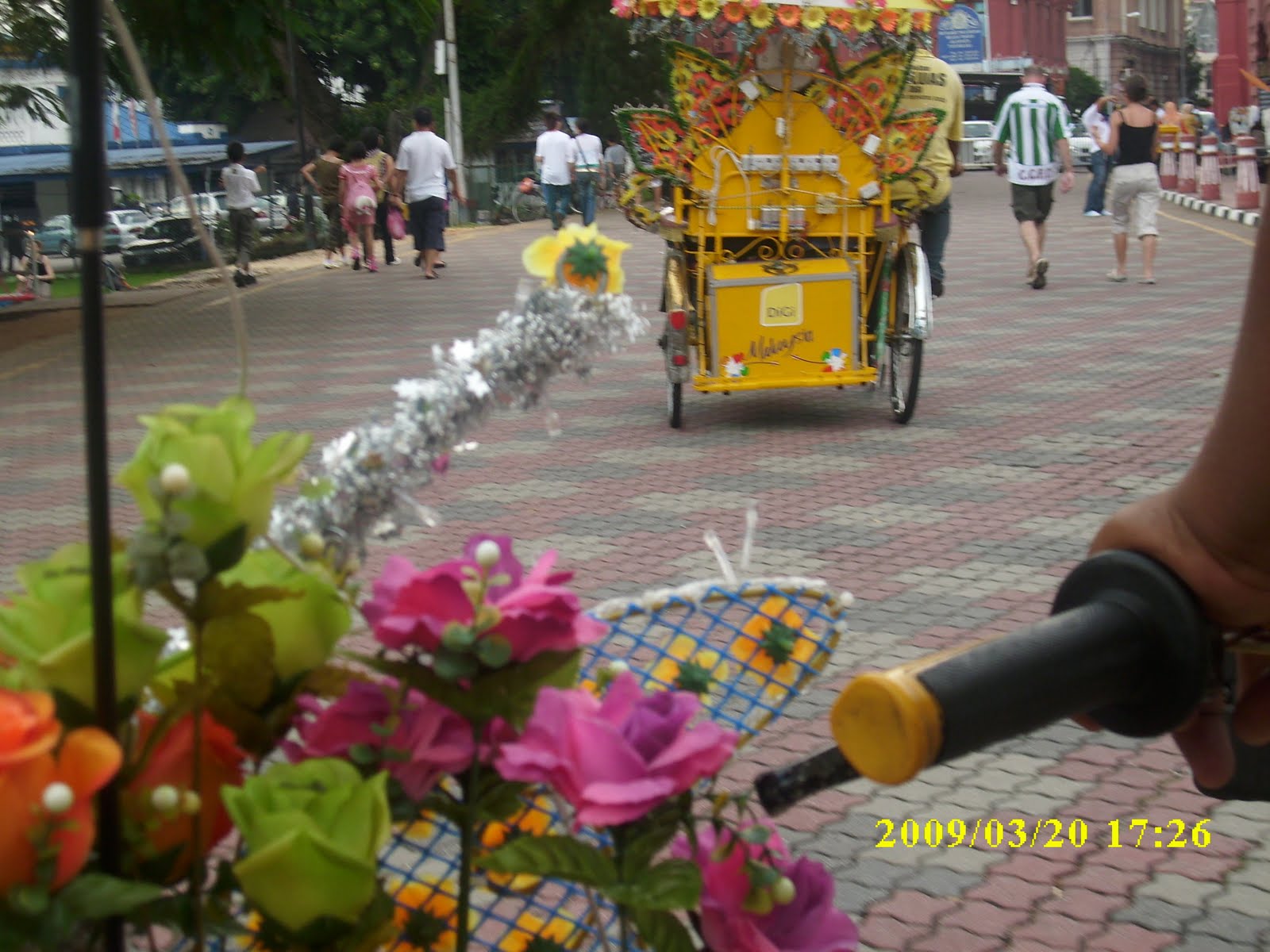
Trishaw also known as tricycle rickshaw or pedicab, is undeniably one of the unique attractions in Melaka. Most of the tourists will be amazed on the efforts of decoration put on the trishaws in Melaka rather than other states in Malaysia. The decorated trishaws were one of the identity or icons of Melaka.


In olden days, before the rolling of industrialization age in Malaysia, trishaw was used as one of the main public transportation modes by residents in Melaka. Due to the modernization of lifestyle and popularization of other efficient transportation alternatives, trishaw has eventually been phased out from daily life of local residents.


However, fortunately, Melaka is one of the only state in Malaysia especially known for its heritage attractions; this has created another alternative of career opportunity for the trishaw drivers, to focus their service target on tourists.


Most if not all, of the trishaws in Melaka are mounted with the seat cabin side-by-side. Examples of place where you can easily find trishaw services available for hiring are The Stadthuys or Dutch Square, Porta de Santiago, and Equatorial Hotel Melaka.


The trishaws which are mainly serving tourism services are all very well and creatively decorated. In addition to artificial flowers arrangement, most of the trishaws are also equipped with an audio player to play popular songs or music at the passengers mother tongue. 


Not surprising, if you hear the Hokkien song playing for Taiwanese passengers. Besides, there are also seen some trishaws equipped with a small fan to ease the heat on scorching day.


In Malaysia, there are only 2 states known with trishaws aimed as tourism service which are Penang and Melaka. However, the trishaws in Melaka are still crowned as the best looking in the region. Sitting on Melaka trishaw for sightseeing tour is definitely a good experience.


Due to the mushrooming tourism value of trishaw services in Melaka, some of the irresponsible drivers have abused the opportunity to charge at irregular rate on tourists. Due to a number of complaints received, the Majlis Bandaraya Melaka Bersejarah (MBMB) or municipal council has taken some measures to regulate the trishaw services in Melaka.


At The Stadthuys, notices on the regulated or standard trishaw hiring rate are visibly seen. On your next visit to Melaka, take a note that the maximum trishaw service rate is fixed at RM40 per hour. Yes, it is regulated to be changed per hour, and never compensate beyond the maximum rate of RM40.


Transportation: Bullock Cart


There were no motor vehicles then and people used bullock carts for travel and to transport goods. Bullock carts were one of the earliest forms of transportation in the country. The driver and passengers sat in the front section of the two-wheeled vehicle and goods were placed in the back. Traditionally used to transport bulk quantities of agricultural products like padi and straw, bullock carts were also used for garbage collection in major towns before World War Two.

But it was no ride in the park. The cart driver was often at the mercy of the stubborn animals. When they were overworked, no amount of persuasion could make them continue the journey. More often than not, the driver had no choice but to wait patiently until the beasts were ready to move again.

This ancient mode of transport is still in use today in places where modern vehicles are considered to be too expensive or when the terrain is too rugged. Closer to home, tourists in Melaka can still go for a ride in a gaily-decorated traditional bullock cart (kereta lembu).

Bullock carts were said to have been introduced by Indian traders during the Melaka Sultanate. Some even sported a woven attap roof to protect against the elements.

Firewood was the main source of fuel for cooking in the early 20th Century as electric and gas stoves had yet to be introduced.

A bullock cart ride is one thing that a visitor to Melaka must not miss out on as it provides an exhilarating experience to both young and old alike.

The bullock cart, which at one time was the main mode of transportation for the rich in Melaka, is unlike those found elsewhere. The carts are beautifully decorated, with bright colours and trappings and has the shape of a pointed roof, similar to the horn of a bull.

Malacca Bullock Carts - Malacca, Melaka

The bullock cart ride area in Ayer Keroh, directly in front of the Orang Asli Museum, virtually comes alive with eager visitors on weekends and holidays.

Although the ride covers only a short distance in the surrounding areas, it nevertheless is an experience not to be missed by all.

Sunday, April 17, 2011

Info: Mousedeer


Mouse Deer are also known as Chevrotain. The Lesser Mouse Deer is the she smallest of all ungulates at a mature size as little as around 45 cm (18 inches) and 2 kg (4.4 lb). The Greater Mouse Deer has the following characteristics:

Body Length: 70-75 cm / 2.3-2.5 ft.
Shoulder Height: 30-35 cm / 12-14 cm.
Tail Length: 8-10 cm / 3.2-4 in.
Weight: 5-8 kg / 11-17.6 lb.

Mouse Deer don't have any horns or antlers, but both male and female possess enlarged upper canines. The male's are prominent and sharp, projecting either side of the lower jaw. They have short, slender legs like tooth-picks, which leave them lacking in agility, but also help to maintain a smaller profile (they need this when running through the dense foliage of their environment).

The female larger Malay mouse deer has the potential to be pregnant throughout her adult life, often having just a 1.5-3 hours break between giving birth and becoming pregnant again! The young are born fully developed, precocious, and can stand within a half an hour after being born. Mothers nurse their young standing on three legs.

Larger Malay mouse deer are nocturnal (only active by night), and hence rarely visible to human eyes. Using tiny, tunnel-like trails through thick brush when traveling, they rest and move at specific intervals several times a day. Extremely territorial by nature, both sexes of larger Malay mouse deer regularly mark their territories with urine, feces, and secretions from an inter-mandibular gland under the chin.

They can be tamed and domesticated easily, however, they are very delicate creatures. When they sense danger, larger Malay mouse deer drum on the ground with their rear hoofs at a frequency of 4 times / per second.

Family group: Solitary.
Diet: Buds, leaves, fruit, and probably small amounts of animal food.
Main Predators: Predators, birds of prey, large reptiles.

The Histoty of Melaka and Mousedeer:

Once upon a time, Parameswara was out hunting at a place called Bertam. While resting under a tree, one of his dogs cornered a white mousedeer or kancil in Malay. In retaliation, the mousedeer kicked the dogs until it fell into the Bertam River. Parameswara was so impressed by the mousedeer’s courage.


Parameswara was shocked with this incident because the size of the mousedeer was very small but it was so brave and strong. Furthermore the color of the mousedeer was white which is very rare. 

Many people believe that is the reason Parameswara believed what he saw as a good omen. When Parameswara decided to build his empire on that sacred land, he will need to name the place. The question will be what is the connection with the mousedeer or kancil story with the name of Melaka actually?

Parameswara named his empire after the tree he was sitting under. (While watching the brave mousedeer defeating his hunting dogs)

Parameswara was also the first Malay prince who was converted to Islam. Later, he took on the name of Sultan Iskandar Syah. It was Sultan Iskandar Syah who laid the foundation for Melaka to become a thriving entreport.

Therefore, the mousedeer story definitely holds some truth especially the part on the good omen.

Melaka Cuisine: Sambal Belacan


A Malay style sambal. Fresh chilis are pounded together with toasted shrimp paste (belacan) in a stone mortar (lesung batu) to which sugar and lime juice are added. Originally, limau kasturi or calamansi lime, is used but since this is scarce outside of Southeast Asia, normal lime is used as a replacement. 

Tomatoes are optional ingredients. Sometimes, sweet sour mangoes or equivalent local fruits are also used. It can be eaten with cucumbers or ulam (leafy herbs) in a meal of rice and other dishes. A Malaysian-Chinese version is to fry belacan with chili.

Melaka Cuisine: Renginang


Renginang or also known as inang-inang is one of the light snacks of Melaka which was named after the title of Melaka palace servants or the royal babysitters (mak inang). It was made of glutinious rice flour, salt and colored flavours. 

Inang-inang is one of the favourite rice snacks for Melaka local people and tourists. Normally you will find a lots of stall selling renginang and other snacks. Melakan love to eat renginang with melted gula Melaka. It is so crunchy and comes with several colors such as red, yellow, green, orange and white.

Melaka Cuisine: Devil Curry


Devil's curry (also known as curry debal in Kristang or curry devil) is a very spicy curry flavoured with candlenuts, galangal and vinegar from the Eurasian Kristang culinary tradition in Melaka. It is often served during Christmas and on other special occasions like Intrudu festival, San Juan, San Pedro and so on.

Kristang cuisine blends the cuisines of Southeast Asia with a western-style cuisine inherited from Portuguese colonial rulers. Other popular Kristang dishes include curry feng, Eurasian smore (a beef stew), and sugee cake.

Melaka Cuisine: Chicken Pongteh


Ayam or chicken pongteh, a chicken stew cooked with tauchu or salted soy beans and gula melaka. It is usually saltish-sweet and can be substituted as a soup dish in peranakan cuisine. Chicken pongteh is one of the most popular Nyonya cuisine in Melaka. 

Almost all Nyonya restaurant in Melaka serve chicken pongteh. The taste is so good and the blend of tauchu and gula melaka or palm sugar will make you love this food. In Melaka, only Baba Nyonya community serve and cook this food.