Showing posts with label People. Show all posts

Tuesday, April 26, 2011

People: Minang Community


The tribal name Minangkabau may be based on a myth that tells of the tribe's victory in a fight between two water buffaloes. As victors, the tribe became known as the Minang (winning) kabau (water buffalo).

A unique aspect of Minangkabau culture is that their society is matrilineal. This means that they recognize descent through the female line. They are, in fact, the largest people group in the world to continue this practice. The strength of their culture is that they have remained matrilineal while embracing Islam.

Their native language, Minangkabau, is distinct, yet related to the language of the Malay and similar to Indonesian.

Over the years, the Minangkabau have migrated to cities and towns in pursuit of business or labor. Today, they are mainly occupied in business and trade, and are renowned among scholars and throughout Western Malaysia for their prominence in business. In fact, they are one of the few ethnic groups that can compete successfully with the Chinese.

The Minangkabau who live in villages have become highly skilled in several home industries. Their businesses include weaving, blacksmithing, and carving. Those who live scattered throughout the countryside are primarily wet rice farmers.

The Minangkabau are the world's largest matrilineal group. Properties and family names are passed down through the women. Marriages are usually arranged by a representative of the family. Young married couples usually live with the wife's mother or another of the wife's relatives.

The woman is expected to manage both a career and the home. Land is owned collectively by the older women, but decisions regarding land usage are made by a consensus, with an elected male elder presiding. Many Minangkabau men leave home seeking wealth and respect. Perhaps this explains why divorce is a very common occurrence.

The Minangkabau possess a wide variety of cultural abilities. Worldwide attention has been given to their distinctive styles of art, music, architecture, poetry, and literature. They also enjoy times of celebration, such as holidays, Islamic pilgrimages, weddings, and house dedications.

Most Minangkabau are Shafite Muslims. They are among Malaysia's most devout Muslims, with many holding important positions of leadership. Religious services are well-attended, and the 'five pillars of Islam' are diligently practiced.

It is very interesting that mythology concerning Minangkabau origin includes the story of a worldwide flood and three brothers who survived on a boat.

The Minangkabau take great pride in their ancestry, claiming to have descended from Alexander the Great. These gifted people have impacted Malaysia in areas of government, the arts, and various professions. Unfortunately, their success has given them a false sense of security, and they appear to have no need for the Gospel. However, changes in familial traditions and increased migration to the cities may provide inroads for the Gospel into this tightly knit group.

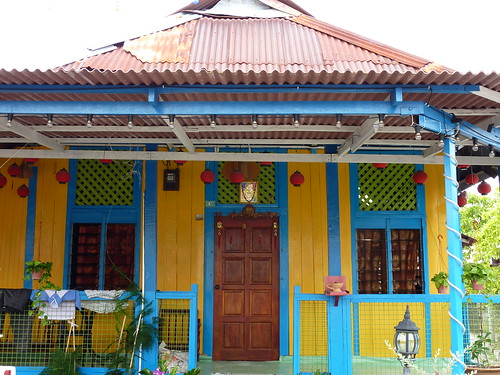
The Minangkabau people migrated across the Straits of Melaka from Sumatra centuries ago and their traditional houses are distinguished by sweeping roof peaks shaped like buffalo horns.

The Minangkabau people of Melaka still practise the matrilineal social system known as the "Adat Perpatih", where the women are the head of the household, making the state the only one to adhere to such social norms.

When the people of Minangkabau, Sumatra, migrated to Melaka in the 12th century, they brought with them not just their kith and kin but their entire system of beliefs and governance.

According to the Minangkabau tradition, clan names, titles, land and property passed through the female lineage instead of the male line.

When they landed in Melaka, the Minangkabau accepted the Melaka sultan as their ruler and enjoyed the sultan’s protection.

However, when Melaka was invaded by the Portuguese in 1511, the Minangkabau shifted allegiance to the Johor sultan as they did not want to come under European rule.

By the 18th century, however, they began governing themselves – out of necessity more than anything, as Johor was then embroiled in internal strife and could no longer offer them protection – and a leader from Minangkabau was selected.


The History of the Naning War in Malaysia, 1831-1832

Also known as the ‘Little War’, the Naning War was an important event in Malaysian history, despite the fact that scholars dismiss it as a “more expansive drama”. The war expressed traditional modes of power-broking and opposition, as well as anticipated later political developments in Malaya. From the wider perspective of imperial history, this important but neglected episode of British expansion in the East.

The origins of the Naning War can be directed at the British incursions to the archipelago allowing the territorial acquisition of Penang (1786), Bencoolen and Java (1811), Singapore (1819) and Melaka (1824); but these had ripple effects throughout the region. 

Naning was a small inland state of 240 square miles situated ten miles north of Melaka town. Between August 1831 and July 1832, the English East India Company was at war with this state, not so much because of what it worth already, but because of its potential worth – “matters concerning land revenue and jurisdiction were bound up with issues such as agricultural and commercial potential and access to its labour”.

The ‘ultimate cause’ of the Naning War was its status in the eyes of the East India Company – they saw the state as a vassal province whose ruler owed his appointment and authority to them. Indeed, there seems to be evidence for this in the Dutch treaty of 1641 and the British one of 1801. However, the ruler, the Malay people and Minangkabau all saw different.

The ruler of Naning, known by his title of Penghulu Raja Mera, had agreed with the Dutch and then later the British, that he would pay a yearly tenth on his rice crops for acknowledgment of his title, though the British continued the practice of accepting instead a token tribute of rice and fowls. “In 1807, however, in consideration of his role as a mere functionary of the Company, they stripped the penghulu of his right to inflict the death penalty and required him to send capital cases to Melaka for trial”.

In March 1827, the Company sent William Lewis, deputy Resident Councillor of Melaka, to Naning to access the situation. Lewis realised the area’s rich economic prospectives and was horrified at the penghulu's exactions, and so told the Company to enforce their full rights in Naning.

“The war was protracted because Naning was the epicentre of a wider power struggle in the interior. In 1758, the Dutch had signed a treaty with Johor placing the inland states of Sungei Ujong, Rembau, Johol and Naning under Dutch protection.

By 1831 the office of Yang di-pertuan Besar was contested. When the new candidate, Raja Labu, came from Sumatra with the usual credentials in 1828, he was backed by the Dato Klana, chief of Sungei Ujong and most senior of the four undang-undang ('lawgivers'), but opposed by Raja Ali of Rembau, an ambitious half-Bugis nephew of Sultan Ibrahim, ruler of the predominantly Bugis state of Selangor.

Ali had exploited family quarrels to seize power in Rembau and now felt threatened by the election of Labu, whose wife was Ali's aunt and one of his fiercest foes. Labu was driven to seek political asylum at Melaka, where he was living in 1831 under the title Yang di-pertuan Besar of Sri Menanti”.

It was the British secret meetings with Rembau, Naning’s ally, that allowed them to defeat Do Syed and Nanning. The state was incorporated into Melaka territory and redefined administratively.

The Naning War may be passed over as a minor dispute in Malaysian history, but on closer examination, we can see its true worth. It was a series of interlocking crises which gripped the Malay world and ultimately, the English East India Company.

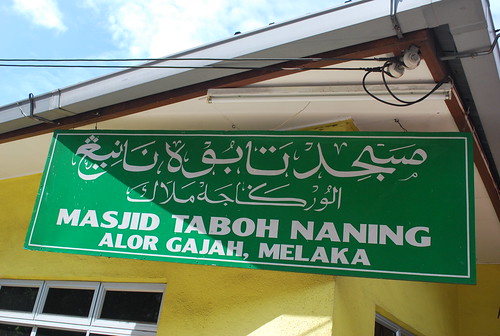
Taboh Naning

Naning Flag

Taboh Naning is the only one province outside Negeri Sembilan that still practice the ‘Adat Perpatih’. There are still headman who control the culture and custom of Pembesar Waris and so on such as the most famous Datuk Naning, Dato’ Dol Said. 4 major tribes (suku) in the Naning province called the Suku Anak Melaka (Meruar), Suku Mungkar (Utar-Utar), Suku Semelenggang (Ular Ular) and Suku Tiga Batu (Tonggo).

Suku Anak Melaka Flag

Suku Mungkar Flag

Suku Semelenggang Flag

Suku Tiga Batu Flag

Taboh is one of the musical instrument also known as ‘gendang’. This taboh is used in many mosque in Melaka before the ‘Azan’ in order to inform to people its time to pray to the god.

Taboh

Naning is a type of spiritual hornet (penyengat) that used by Dato’ Dol Said to attack the British in Naning War but then those hornet dissapeared after the British army poured the pigs blood to the hornet’s nest with the help from Rembau people who were disloyal to Dato’ Dol Said and Naning State.
HALAMAN DATO UNDANG NANING MELAKA

List of Datuk Naning

1. Megat Alam Melintang 1641-
2. Megat Junjungan Limau
3. Juara Megat
4. Kokah Bernama Zohri
5. Gahang Berbulu
6. Selamat Idris
7. Timbo
8. Anjak
9. Dol Said bin Omar 1799 - 1849
10. Idas 1849 - 1870
11. Mohd Salleh @ Aghap bin Rahim 1870 - 1900
12. Ranting 1900-
13. Hassan 1916
14. Omar 1918-
15. Arshad 1923 - 1932
16. Osman bin Kering 1932-
17. Cek Lah bin Mohd Sab 1949
18. Dato' Mohd Shah bin Mohd Said al-haj 1951 - 2006
19. Dato' Abdul Latif Hashim 2006 - current

Orang Kaya Seri Raja Me'rah YAM Dato' Abdul Latif Hashim and Toh Puan Sahzizan Deris

Dato' Dol Said's Mausoleum


Dato’ Dol Said, the ninth ruler of Naning who defiantly opposed the imposition of tax on the district by the British. He valiantly resisted British forces on Naning, deploying his troop with outstanding display of military ingenuity that outsmarted the invading forces on two campaigns.

The Naning War, waged in 1834, made Dol Said a hero of exceptional valor that earned him a permanent place in the history of Melaka. He was buried here at Taboh Naning, about 32km from Melaka city.

Cuisine


Traditional Melaka Minang food is hot and spicy, as one of the ingredients used is the chili padi, the hottest of chillies. Popular dishes include rendang, (pieces of beef cooked in coconut milk and chillies). One should experience the unique Minangkabau style of cooking, which sees generous portions of 'chili padi' (small & extremely hot chilies) being used.  Try the "Masak Lemak Chili Padi - fish, meat, or vegetables cooked in coconut milk blended with turmeric and ground chili padi.

Another Minang specialty is "Lemang", glutinous rice cooked in coconut milk in a bamboo stem over an open fire. This is normally served with Rendang, a deliciously thick, dry meat curry.

Lemang Minang

Rendang Maman

People: Chitty Community


The Chitty are a distinctive group of Tamil people found mainly in Melaka and Singapore , who are also known as the Indian Peranakans. As of today, their population stands at 2,000.

Language

Like the Peranakans, the Chitty speak a Malay patois, which is mixed with many Tamil loan words. Many of the Chitty are unable to communicate in Tamil fluently.

History

Historical records stated that the Tamil traders from Panai in Tamil Nadu settled down in Melaka during the sovereignty of the Sultanate of Melaka. Like the Peranakans, they later settled down and freely intermingled with the local Malays and Chinese settlers. However, with the fall of the Melaka Sultanate after 1511, the Chitty eventually lost touch with their native land.

Under the administration of the Portuguese, Dutch and British colonizers, the Chitty eventually began simplifying their culture and customs by adopting local customs. This can be evidenced in the architecture of the Sri Poyatha Moorthi Temple, which was built by Thavinayagar Chitty, the leader of the Chitty people, in 1781 after the Dutch colonial government gave him a plot of land.

The traditional Chitty settlement is located at Kampung Tujuh along Jalan Gajah Berang, which is also inhabited by a small number of Chinese and Malays as well. Many of the Chitty have since found jobs in Singapore and other parts of Malaysia.

The ethnic identity of the Chitty is nearly lost. As many of them are assimilating into the mainstream Indian, Chinese, and Malay ethnic communities culturally, this small but distinct group of people that has survived for centuries is now on the brink of extinction.


Appearance

The Chitty are a mixed people. Although they ethnically consider themselves to be Tamil, who have a Dravidian appearance and dark complexion, the Chitty appear to have varying degrees of Southeast Asian and Dravidian looks.

This resulted from the fact that the first Tamil settlers took in local wives, since they did not bring along any of their own women with them. Over time, the Chitty gathered physical features that were less Dravidian, and more Malay-looking.

Religion

The Chitty community are Hindu, worshipping in their three temples. Gods such as Ganesh and Shiva are worshipped in full gaiety. Hints of Taoist and Islamic influences are also evident in their religious rituals.

Chitty Wedding Ceremony

Culture

Culturally, the Chitty have largely assimilated into the Malay culture with some Chinese, Dutch and Portuguese influences, although certain elements of Indian culture do remain. This is especially true in the case of marriages, where offerings of fruits and burning of incense are used. In the case of food, Malay spices, ingredients and the way of cooking have largely supplanted the Indian style.

Chinese cultural influence is also evident, especially in the case of ancestral worship. Religious objects used for conducting rituals were also used by the Chinese. The Chitty are also influenced by the Chinese to some extent in their ceramics works of art.

Simplification of Tamil architecture among the Chitty is also present. Distinct from the Tamil, who have a complex Dravidian Temple Architecture in the Pallava style, that displays beautifully carved out sculptures of the Hindu gods in many rows, the Chitty temple tend to only have one row of these, or a picture of one single god in each of the three rows, as evidenced in the Sri Poyyatha Vinayagar Moorthi Temple, built by Thaivanayagam Chitty in 1781.

Sri Poyyatha Vinayagar Moorthi Temple

Dress and lifestyle

Most of the Chitty have adopted the Malay costume. In the case of men, a comfortable sarong and Malay shirt may be worn, although a songkok may also be worn, especially for a Muslim. Women, on the other hand, wear a similar costume that are similar to the Peranakan Nyonya.
Alongside their Chinese and Malay neighbors, the Chitty live in Kampong houses. Pictures of Hindu gods and Indian names can be seen just outside their houses, as their descendants tend to adopt Indian, rather than Malay surnames.

Costume of the Chittys


Men:
A dhoti and shirt for religious functions, while for traditional events they will wear the sarong or kain pelekat with the loose Nehru jacket and a cap. A piece of colorful cloth is often draped on the left shoulder.


Women:
A kebaya panjang or kebaya pendek depending on marital status, with a sarong. The handkerchief or binpoh is worn on the shoulder like a shawl.


A typical Chitty home is distinctly marked by mango leaves arranged in a row, dangling from above the front door. Chitty temples are also adorned this way.

Chitty's popular dish, Nasi Kembuli

Festivals and Celebration


As for festivals, the Chittys celebrate three types of "Ponggol Day" which are "Thai Ponggol", "Maatu Ponggol and "Kaani Ponggol". Ponggol Day is also known as a harvest festival. Thai Ponggol, is a celebration for harvesting process, while Maatu Ponggol is a celebration to show gratitude towards cows and buffaloes. As for Kaani Ponggol, it is to dedicate to everyone who work hard during harvest time. For that reason, they will visit many places of interest during this festival.

The celebration for harvest festival took place in January on a grand scale.

One of the main festival is the "Bhogi Parachu" usually falls in January. Chittys make offerings to their ancesstors during this festival. God is worshipped for bringing rain for the plantation. Bhogi will be celebrated four days before the Ponggol festivals. It is celebrated early in the morning whereby all the family members gather in front of their house and set a big fire to worship their God.

Kampung Chitty Headman pouring a milk into coking pot during the ceremony of Ponggol

The Heritage Village of The Chittys

Chitty's Museum

The Chittys have been around since the reign of Parameswara. Back then, most of them belong to the group of traders who were living in Kampung Kling and Kampong Belanda. They originated from the Coromandal Coast, Kalingapatnam, South India and Tamil Nadu.


In the earlier days, they were Chittys holding high posts in the government administration. However things began to change during the Dutch colonization. The Chittys were imposed strict supervision in their trading which eventually caused them to move to remote areas such as Gajah Berang, Bachang and Tengkera.


As a result of the incident, many Chittys decided to switch their profesion from trading to agriculture. The present Chetti settlement in Gajah Berang is under the administration of a trustee by the name of Kovil Sri Poyyatha Vinayagar Moorthi.

People: Javanese Community


The Orang Jawa ('people of Java', also known as 'Javanese' - Wong Jowo) migrated from Central Java, Indonesia, to Malaysia from 1600 to 1930. They migrated to seek a new life away from the Dutch colonists who ruled Indonesia during that time. 

The Javanese came in Peninsular Malaya since early times. Portuguese historian De Barros mentioned that there were 10,000 Javanese in Melaka in early 16th century. Among the first Javanese settlement in Melaka is Kampung Jawa. They were administered with autonomy under their chiefs. Their settlement contributed to the multi-ethnic nature of Melaka. Link between Java and Melaka was important during spread of Islam in Indonesia, when religious missionaries were sent from Melaka to seaports in northern coast of Java.


The migrants bring with them various aspect of Javanese cultures such as Gamelan music, traditional dances, foods, and art of Wayang kulit shadow play.


Today the Orang Jawa live throughout Peninsular Malaysia in parts of Perak, Selangor, Johor, Melaka and Kedah. There are also isolated communities in coastal areas of Sabah. Some Java have even gained influential positions in society.

The Java language is being spoken less and less among today's younger Orang Jawa. Most of them have either never learned it or cannot remember how to speak it like me.
  
In some Java traditional villages in Melaka such as Kampung Parit Gantong, Kampung Parit Penghulu, Kampung Parit Perawas and Kampung Parit Putat in Sungai Rambai, Paya Dalam,   Tambak Paya, the Orang Jawa maintain their identity and traditions. People from other Malay people groups who marry into an Orang Jawa family sometimes call themselves Orang Jawa, or Jawa Peranakan. Apart from growing their own vegetables and raising poultry, some villagers have also started their own tourism programs to promote the Javanese way of life like my village, Agrotourism Homestay Kampung Parit Penghulu.

The Orang Jawa are a very hospitable people and friendly, usually inviting visitors to share a meal with the family members. Families are often quite large, some having between 10 and 17 children. Marriages are grand affairs that sometimes last up to three days. The giving of love gifts to the newlyweds is common. Emphasis is placed on helping one another during weddings rather than receiving large sums of money. As the Orang Jawa have become more successful in life, their desire to recover their cultural Javanese roots has grown.

The Orang Jawa are predominantly Sunni Muslims. During weddings and circumcision rituals they perform the jedur (songs of praise to the prophet Mohammed) which is compiled in a book called Silawatan. They also perform the kempling (a type of dance giving praise to Allah) during religious occasions.


Arts and Performances

Kempling

During the performance, they use a tool made from lamb's wool and wood. The Qur'an is read before and after the dance, and it takes a group of between ten to twenty people to perform it. The kempling performance is an opportunity for the Orang Jawa to get together to build ethnic solidarity and unity. It is also a time for discussing the challenges faced by the villages.

The Orang Jawa Melaka have a strong Islamic background. Pray that communication bridges into their culture could be used to meet the spiritual needs. Pray that the lives of committed believers will be a positive influence and could bring about good relationships with Orang Jawa people.

Kuda Kepang

Barongan

Kampung Jawa

Java Lane, or Jalan Jawa, is a small lane on the northern bank of the Melaka River. It is located on the buffer zone of the Melaka UNESCO World Heritage Site. Today it is celebrated as a heritage lane due to its position as one of the earliest urban redevelopment schemes in the country. 

The lane can be accessed from the iron bridge across the Melaka River, or through its either ends that form a letter "C" that opens to Jalan Bunga Raya. Java Lane was built around 1880, in a project spearheaded by Tan Hoon Guan (1842-1912), a Melaka merchant, as an urban renewal effort. On both sides of Java Lane are residential houses and shophouses.


Java Lane is regarded as the first modern public housing scheme in Melaka, and quite likely, in the whole of Malaysia. Its construction introduced new sanitary as well as fire-prevention methods in town planning.

Before Java Lane was built, the area was already known as Campong Java. It was a Javanese settlement that had existed since the Dutch period. The settlers made a living out of fishing and trading. The Javanese had been in Melaka even earlier, since the Portuguese period, and possibly even before then. Until the Portuguese period, they had inhabited the site across the Melaka River, in the area where Bridge Street (Lorong Jambatan), Jalan Kampong Pantai and First Cross Street (Lorong Hang Jebat) are now located. However, they moved across the river during the Dutch period, possibly as their position in Melaka began to decline. Today the area between Melaka River and Java Lane is still regarded as Kampung Jawa.


By the late 1880's, the expanding population of Melaka resulted in the urbanization of Campong Java, with the construction of Java Lane and the building of brick houses to replace the traditional attap dwellings. 

While the new houses were considered vastly more comfortable, little is documented of the unheaval forced upon the inhabitants of the kampung. In the process, many village houses had to give way. Nevertheless, there are still a few Malay houses within the Java Lane area. They are now engulfed by the urban houses and shophouses that were built since the 1880's. The Madrasah Al-Hidayah stands on the site of an old Malay mosque.


Another wave of change swept the Javanese community of Java Lane in 1920, when the British authorities decided to built a new market there. The Javanese and Malays living there were relocated to a new village called Kampung Morten, name after the Land Commissioner at that time, J.F. Morten.

Cuisine

Some popular Javanese cuisine in Melaka are tempe, melinjau crackers, Nasi Ambeng, sambal lada hiris, sambal jawa, pecel, lepat, telur pindang and masak kicap.

Nasi Ambeng or Ambengan

Pecel

Melinjau

Telur Pindang

Most of the Javanese food in Melaka are sweet and hot. The most famous food originated in Java is perhaps tempe, a meat substitute made from soy bean fermented with mold. It is a staple source of protein in Java and popular in the world as an excellent meat substitute for vegetarians.


Raw Tempe

Fried Tempe

Monday, April 25, 2011

People: Bugis Community


The people of Bugis-Makassar is the residents of South Sulawesi. This people is famous for their expert in sailing on the deep ocean. As a sailor they have spreaded over many areas of Indonesia such as North Sumatera, Malaysia, Kalimantan, Java, Bali, Maluku, Sumbawa, and West Flores.

When the Dutch invaded Indonesia in 17th Century, apart of them migrated and mixed altogether with other tribes in Sumatra, Kalimantan, Java, Peninsula Malaysia, Sabah and Sarawak. They are the traders and very good in economic activities. They are also good in maritime in Peninsula Malaysia. They are well-known with their brave warriors, pirates and traders.

Bugis ship

The centre for Bugis culture and economic activity is Ujung Pandang or also known as Makassar. They are Muslim and plays an important role in Peninsula Malaysia history. They involved in politics and the administration of Peninsula Malaysia especially in Johor.

They have their own language called Bahasa Bugis or also know as Ugi. The consoant in the Ugi language are called as Lonatara which were based on Brahmi words.

La Galigo

La Galigo is the longest epic in the world. It exist before the Mahabrata epic. La Galigo could’t be used as history text or reference because consist of myths and outstanding story that could’t be real. However, the epic could give the overview of Bugis culture before 14th century. La Galigo consist of poetry in Bugis words. The epic was about the Sawerigading, a brave warrior and immigrant.

The story of Sawerigading is very popular among Bugis descendant in Malaysia. The epic was brought to Malaysia by the Bugis who immigrated to Malaysia. In 15th century, Melaka was under the reign of Sultan Mansur Syah was attacked by 'Keraing Semerluki' from Makassar. Semerluki was probably Karaeng Tunilabu ri Suriwa, the prince of Tallo’ Kingdom or his real name is Sumange'rukka' and he intended to attack Melaka, Banda and Manggarai.

In the 16th century, many Bugis migrated to Peninsula Malaysia and some of them came to Melaka and open new villages such as Pulai, Serkam, Umbai, Tambak Bugis, Telok Mas and Merlimau. Those villages was open by the Bugis people and they live there with their own culture and traditions.

Kampung Tambak Bugis

A new power arose in the 18th century. A people called the Bugis originally came from Sulawesi. At the end of the 17th century they began to settle, peacefully, in the territory of Johor. They were allowed to settle but they soon became very powerful.

In 1717 a man named Raja Kecil claimed he was the son of the assassinated Sultan Mahud. He and his followers seized the capital of Johor. The reigning sultan, a man named Abdul Jalil, was overthrown. However he fled to the east coast of the Malay Peninsula with his followers and set up a rival court there. From then on both men claimed to be the ruler of Johor.

Abdul Jalil was murdered on the orders of his rival, Raja Kecil. The Bugis then turned on Raja Kecil. They captured the capital and made Abdul Jalil's son Sulaiman ruler. However Sulaiman was only a puppet ruler. From then on the Bugis held the real power.

The people of Bugis is an obedient people to their original tradition although those who already live outside South Sulawesi. Their sacred tradition called panngaderreng or panngadakkang. 

The tradition is based on elements namely:
1) Ade/ada an ethic of marriage, kinship, generation, relation among relatives, and the ethic on politic.
2) Bicara is the procedure of law proceedings and judgment,
3) Rapang can be said as samples, analogy, or metaphors of past events to be used as reflection of life.
4) Wari, ethic of classification on objects and social matters,
5) Sara, social organization and Islamic rules.

Bugis people is well known for their craft of making phinisi wooden ship can be used to sail on the deep ocean. As the producer of wooden ship they also professional on sailing to any ocean.

People: Sikh Community

The Punjabi or Sikh community came to Melaka from India, and brouhght their religion, Sikhism, with them. Originally made up of police and other security personel, later arrivals of Sikhs included the business and professionals classes. 

The religion is based on the concept of there being only one formless God and, as a result, idol worship is banned. there are Sikhs Temples, or Gurdwaras, sited all over Melaka.

Festivals


The Two major Sikh Festivals are:

1. Birthday of Guru Nanak on December 22.
2. Vasakhi the Sikh New Year on April 13.


Religion

Gurdwara Sahib, Melaka


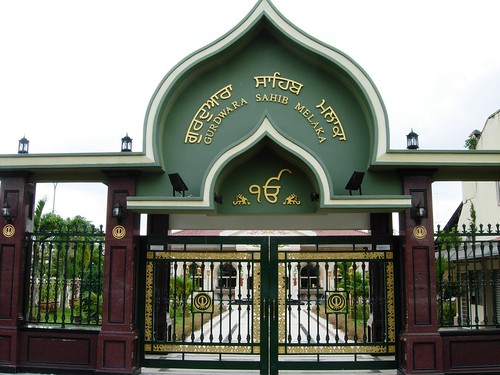
This gurdwara was built in 1925. It serves 80 local Sikh families in Melaka. Prayers will be held on every sunday morning. Yearly barsi held for Sant Sohan Singh Ji, on 24th May or about attracts around 35,000-40,000 Sikhs from all over the world. The original building based on Portuguese artitecture also now has separate buildings housing Sant Sohan Singh complex and Dharmik Vidyala.


Located in centre of Melaka Town at Jalan Temenggong. Accomodation are available for sikh visitors apart from Barsi period.

The Sikhs in Melaka are a very small and homogenous community. Other communities associate them with their turbans, their sharp features, colourful costumes and delicious chapattis. 


In the Sikh or Punjabi community, the male is known as ‘Sikh’ and the female is known as ‘Kaur’. Known for their colourful culture, Bhangra is a traditional Punjabi musical art form that is increasing in popularity all over the world. 


Bhangra


Some of the basic beliefs of Sikhism are:

1. There is only one God, the sole creator, sustainer and destroyer. Sikhs do not believe in duality, but unity in diversity. God cannot take on the human form. Daily prayer and devotion to God and His Creation is required.


2. The rejection of the divisive Caste system. Sikhs reject any distinction made for class, race, creed or sex. Sikhs believe in full equality for all people.

3. The Sikh goal is to end the cycle of birth, death and rebirth, and unite the separated individual soul with the Universal Soul (God). The way to attain this goal is through applying the teachings of the Gurus to all situations, continuous meditation on the Holy Name, selfless service, control of mind and correct regulation of desires and impulses.

4. In Sikhism there are 4 cardinal sins (Kurahts). Sikhs should not; cut their hair, commit adultery, use tobacco or other drugs and not eat ritually slaughtered meat, such as halal meat.
Sikhism identifies 5 vices, which a Sikh must regulate and control. These are: Kaam (lust), Krodh (anger), Lobh (greed), Moh (worldly attachment) and Ahankar (egotism).

5. Blind rituals such as idol worship, yoga, superstitions, pilgrimages and fasting are prohibited.

6. The recognition that the Sikh sacred scripture, the Guru Granth Sahib, is the eternal Guru and that there will be no more human Gurus.

7. To protect and help those in need through charity and community service.

Langar


A langar is a free community kitchen found within most Sikh temples. Its roots go beyond the strengthening of community through meals. It offers a beautiful practice of social liberation and oneness. 

Sikhism, emerged from the Hindu region of Punjab, where caste hierarchies dictate even who can sit at a table together. The Sikh religion rejected this system. Men and women, rich and poor, Sikhs and non-Sikhs all participate equally in creating food and sharing it together in the langar.


Traditional Costumes

The Sikh turban, known as the Dastar, is mandatory for all Khalsa Sikhs to wear. It will vary by caste, class, religion and region. It also serves practical functions like protecting from the elements, used as a pillow, blanket or towel. When unravelled, it is used like a rope where it is tied to a bucket to draw water from the well.


Turban

Their traditional costumes consist of a ‘kurta’ or ‘baana’ for the male - normally worn with a turban - and a Punjabi suit or ‘lehenga’ and shalwar khameez for the female. 

The Punjabis celebrate Vaisakhi, the Sikh’s New Year and Harvest Festival.

Vaisakhi


Cuisine


Many Sikhs do not eat meat. Sikhs eat a special sweet.  It is called the Karah Prashad.  It is made from sugar, butter, flour and water.


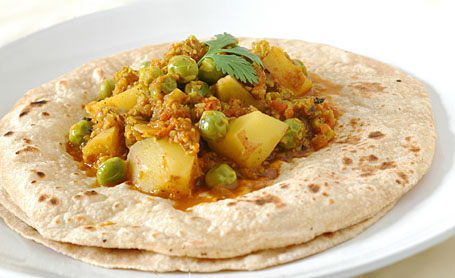
Sikhs have food at the temple on special days.  Favourite food are chapatis and vegetable curry.  Eating together shows all Sikhs are equal or the same.

Karah Prashad

Chapatis and vegetables curry